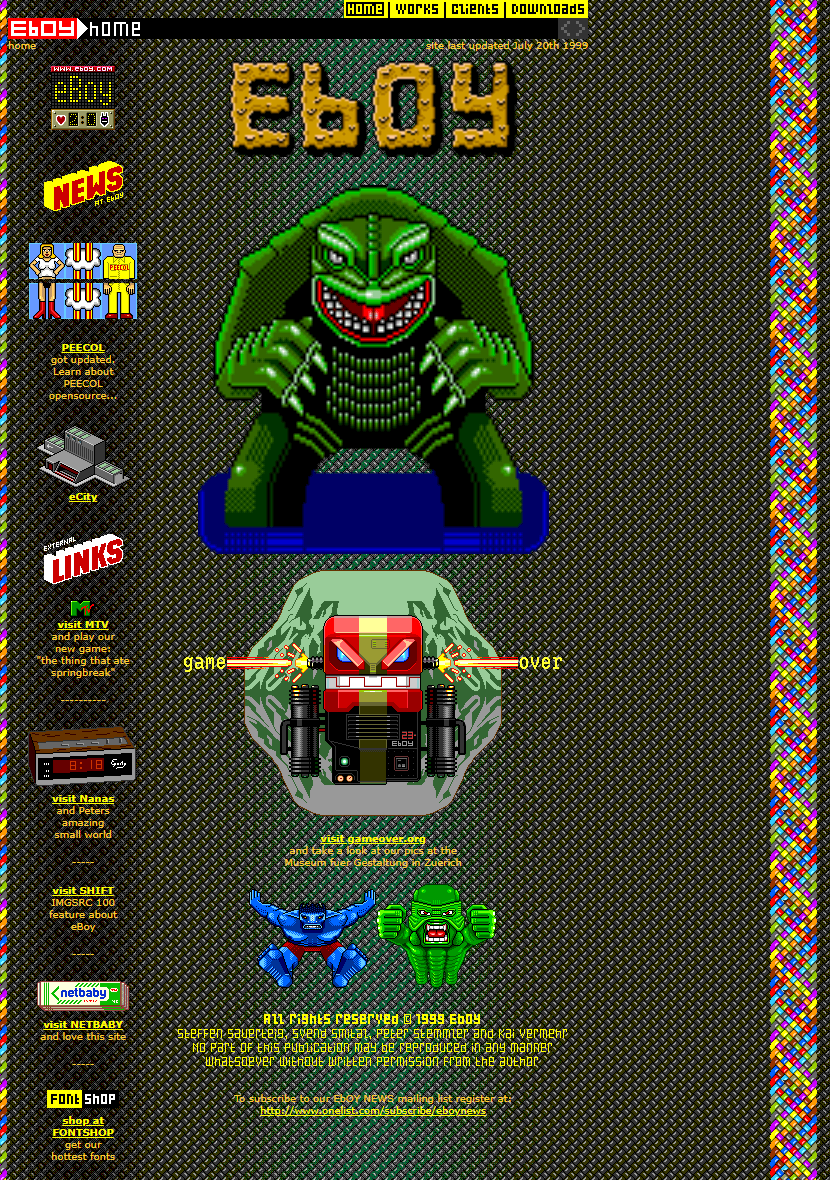
Website1998 – 1999
eBoy — Pixel Art Collective Homepage
Dense isometric sprites and crumbly bitmap type on a cross-hatched CRT canvas.
Hand-placed sprites and type drawn on the pixel grid
A craft tradition of the small-screen web in which every graphic was drawn pixel by pixel — indexed-colour GIFs, tiled bitmap patterns, bitmap typefaces and icon sprites made for displays measured in hundreds of pixels.
Working palette — eight colours, no gradients, no anti-aliasing.
The bitmap never changes. Only the lookup table does — which is how a recoloured sprite cost no extra bytes.
A few hundred bytes, repeated forever. Whether it reads as a texture or as a grid depends entirely on what happens at the edge.
Edges continue into each other, so the repeat disappears.
Live specimens of a web drawn one pixel at a time — indexed-colour sprites, isometric rooms and bitmap craft made for displays measured in hundreds of pixels.
Dense isometric sprites and crumbly bitmap type on a cross-hatched CRT canvas.
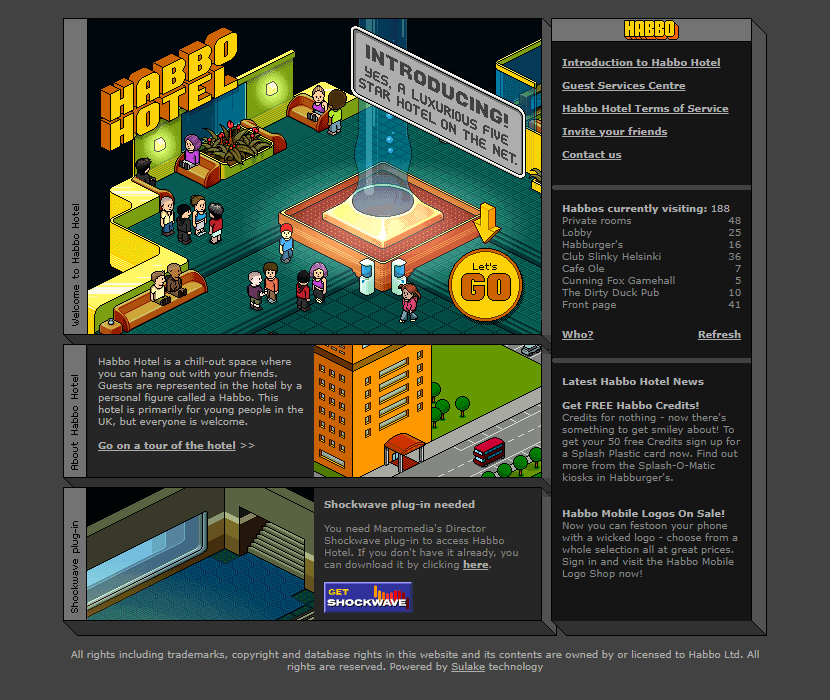
A commercial virtual world built entirely from tiled rooms and avatar sprites.
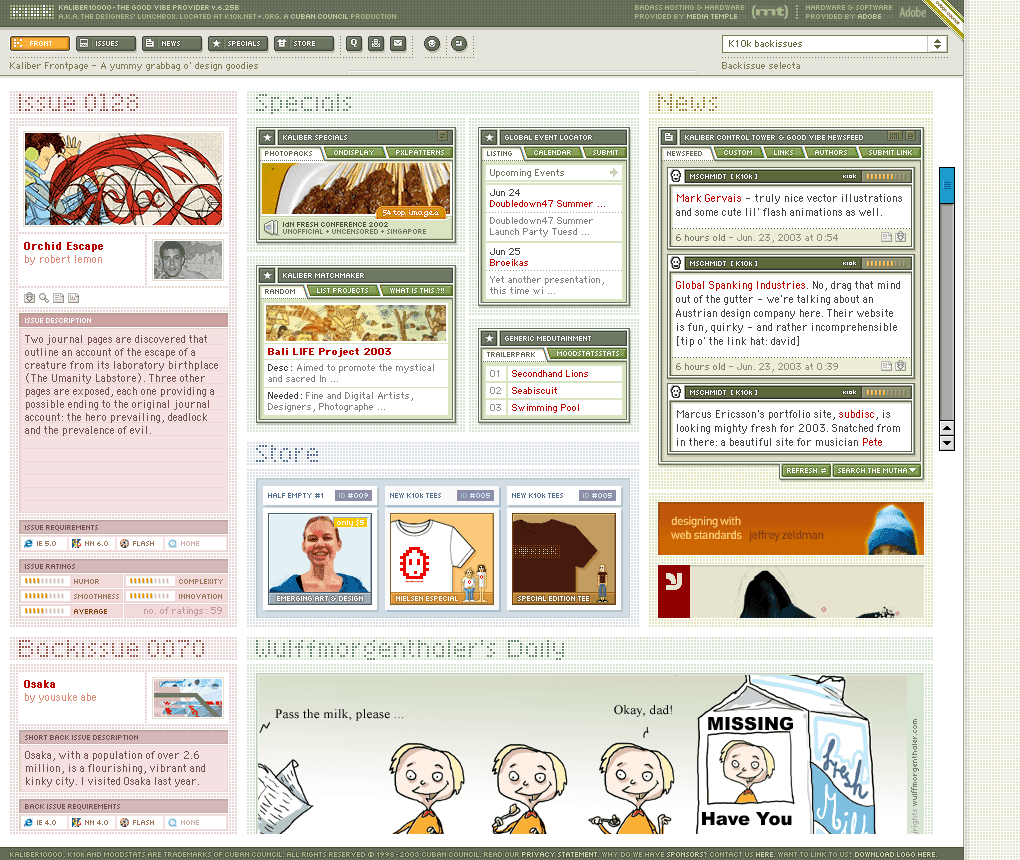
A design-community portal that wore its pixel craft as editorial identity.
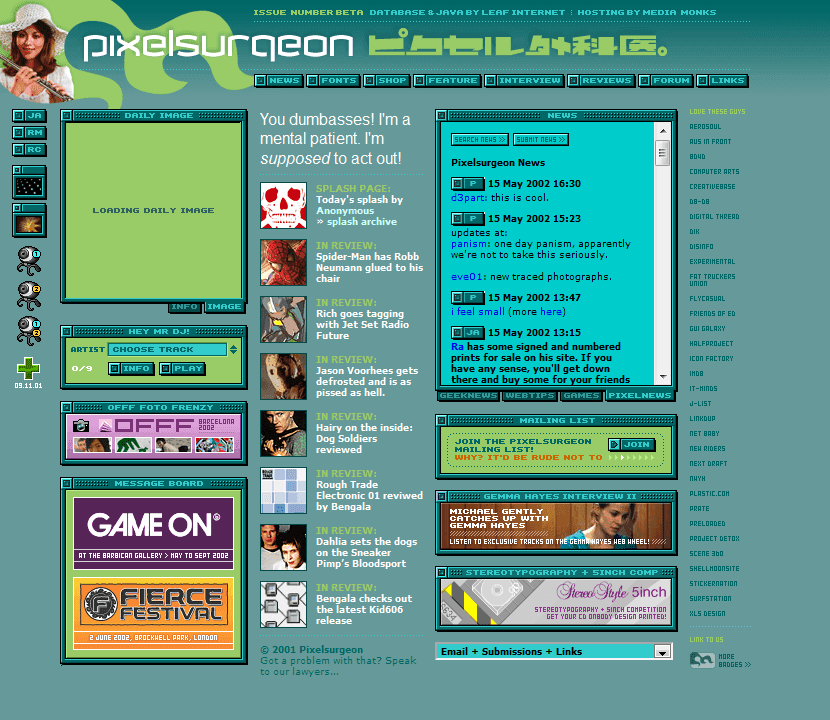
Community gallery chrome built from hard edges, sprites and indexed colour.
Through the late 1990s a typical browser window was roughly 800x600 pixels on a CRT, images travelled over dial-up, and the GIF format stored a small indexed palette without loss. Those three constraints together rewarded graphics that were drawn, not photographed: a lossless indexed image with flat colour compressed to a few kilobytes, while a photograph did not. A distinct discipline grew around that. Designers worked at 1:1 in MS Paint, Photoshop with the pencil tool, and Macromedia Fireworks, placed single pixels deliberately, and built interfaces out of tiled background patterns, small sprite icons and bitmap type. It overlapped with the amateur homepage scene but was not the same thing: GeoCities pages mostly assembled clip art and defaults, while pixel work was authored, with a chosen palette and a consistent light source. The practice was carried further by browser games and virtual worlds, by hobby communities trading dolls, avatars and icon sets, and by tiny bitmap typefaces that made 6-pixel text legible on screen.
Matthew Carter draws Verdana for Microsoft with the pixel grid as the primary target rather than the printed page, giving the web a body face that stayed legible at small sizes.
Jason Kottke publishes Silkscreen, a typeface drawn on the pixel grid and legible at very small sizes, which spreads quickly through web and interface design.
A 16x16 bitmap icon becomes part of every website, turning deliberate pixel drawing into a routine requirement of shipping a site.
Habbo Hotel launches with an entirely pixel-drawn isometric world, and browser-based pet and community sites make sprite graphics the default look of the social web for younger users.
Faster connections, CSS-driven layout and higher screen resolutions remove the reasons to hand-place pixels; smooth vector and photographic work takes over mainstream interface graphics.
Commissioned Verdana for on-screen reading, shipped MS Paint as a universally available 1:1 pixel editor, and introduced favicon.ico in Internet Explorer 5.
A graphics editor built specifically for web output, with control over indexed palettes and GIF export that kept hard pixel edges intact.
Jason Kottke’s free bitmap typeface, drawn to be read at sizes where outline fonts turn to mush — used across interfaces, navigation and captions.
Yuji Oshimoto’s family of very small pixel typefaces, distributed free and adopted widely for labels, menus and game-style interfaces.
A browser-accessible isometric virtual world built entirely from pixel art, which proved that sprite graphics could carry a large commercial product.
Hosted a large pixel-art community that circulated palettes, tutorials, icon sets and dolls, keeping the craft organised and teachable.
It was the only approach that satisfied every constraint at once. A drawn, indexed-colour image was small enough for dial-up, sharp on a CRT at 1:1, legible at the sizes interfaces actually used, and reproducible across the whole range of hardware people browsed on. It also had a low barrier to entry — MS Paint shipped with Windows — so a visual craft grew in public, with palettes and tutorials passed around freely.
Every constraint that produced it disappeared. Broadband removed the file-size pressure, CSS took over layout from sliced image tables, display resolutions climbed past the sizes the artwork was drawn for, and browsers began smoothing scaled images by default, which turns deliberate pixels into blur. Bitmap typefaces in particular only work at one size, so they could not survive fluid, zoomable and later high-density displays.
Vector and photographic interface graphics, Flash and then CSS-driven visual effects, and eventually icon fonts and SVG — all of which scale to any resolution, which hand-placed pixels cannot.
Pixel work left the web a durable set of habits: the favicon is still a deliberately drawn tiny bitmap, sprite sheets became a standard performance technique, and the discipline of designing to an exact grid at an exact size survives in icon design. The aesthetic itself returned as a deliberate choice rather than a constraint once CSS gained image-rendering controls that let browsers scale bitmaps without smoothing them.
2000
An isometric pixel-art virtual world reached through the browser, drawn entirely in sprites and tiles.
1999
A browser pet community whose pixel-drawn creatures, items and shop interfaces were the visual language a generation learned the web through.
1999
A bitmap typeface designed for tiny sizes, which became shorthand for the whole look when used in navigation and captions.
A badge size that became a de-facto standard, forcing an entire visual statement into a fixed 88 by 31 pixel rectangle.
GIF stores an indexed palette without loss, so it preserved hard pixel edges that JPEG compression smeared — which is why the format and the craft are inseparable.
Bitmap typefaces must be used at their exact design size or an integer multiple of it; at any other size the glyphs fall off the pixel grid and become unreadable.
Verdana was drawn for the screen first and the printed page second, reversing the order every typeface before it had been designed in.
The favicon began as a 16x16 bitmap in Internet Explorer 5 and is still, on most sites, the smallest image anyone drew on purpose.
The 1x1 transparent GIF used to prop open table cells was, for years, one of the most-requested files on the entire web.